Guide
How to Become an AI Trainer (and Who Actually Gets Hired)
Updated 7 days ago ·
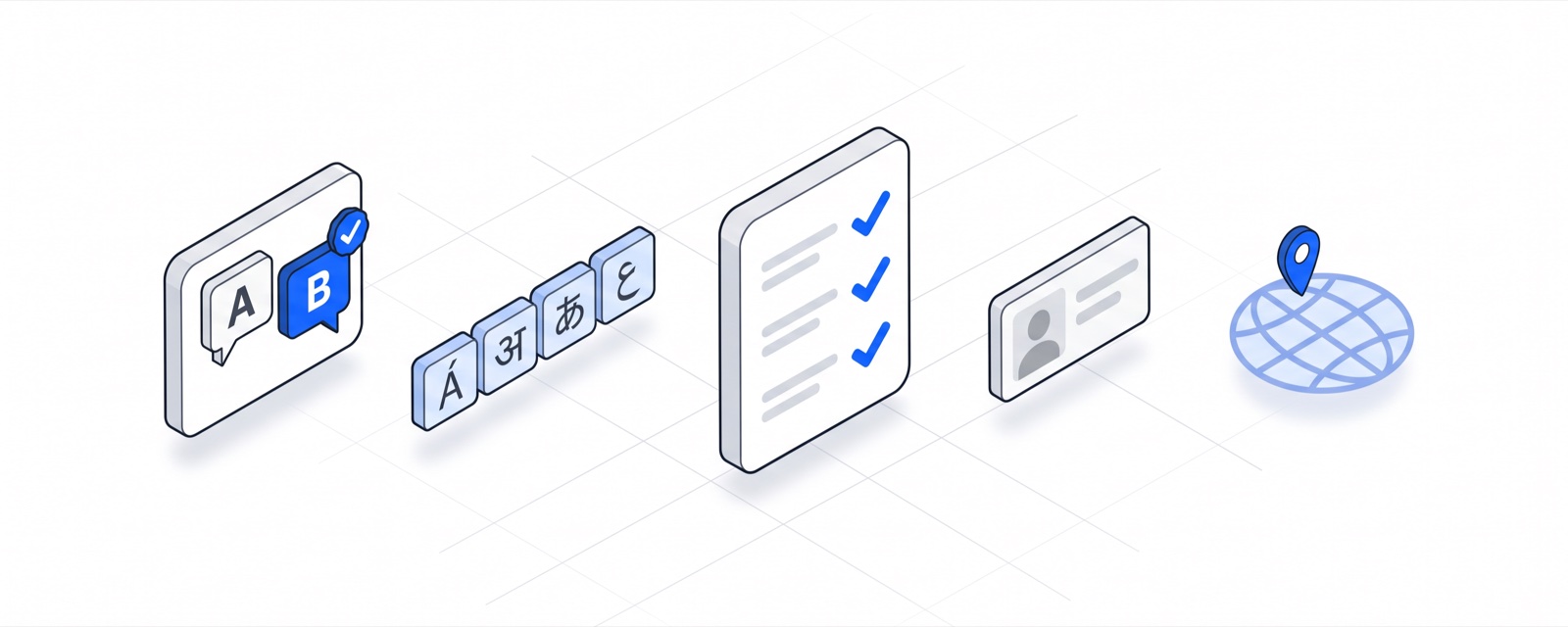
How to become an AI trainer: choose a track you fit (language, generalist or specialist), apply on the platform's own site, pass its test or AI interview, and verify your ID. Just 4% of the 2,136 AI-training jobs we track take complete beginners.
Key takeaways
- Barely 4% of the 2,136 AI-training jobs (85) ask for no experience; 41% sit in specialist fields.
- The widest route in is language: 52% of jobs list a non-English language, and 67 of the 85 beginner jobs are language roles.
- 36% of search-rating jobs ask for no experience; coding jobs sit at 0%.
- Of the 1,911 jobs stating who may apply, 64% hire in one country and 22% are open worldwide.
- Pick by fit: native speakers go to RWS TrainAI, Meridial or Welo Global; licensed professionals to Mercor or micro1; US students to Handshake AI; English writers to DataAnnotation. Filter live jobs by country and level on AI Trainer HQ first.
Most guides promise "no experience needed" or say to get a degree first; neither shows which jobs would take you. Each application costs an unpaid test, and most jobs hire in one country. So we counted who 2,136 live AI-training jobs hire and mapped eight platforms' hiring steps.
What does an AI trainer actually do?
An AI trainer does contract work writing, rating and correcting AI answers so a model learns what a strong response looks like. A typical assignment shows two chatbot replies and asks which is better and why, the human-feedback step described in Ouyang et al. (2022). Other work includes writing ideal answers, rating search results, recording your voice, labeling data and red teaming.
Graders review each task against written guidelines. It isn't machine-learning engineering. For real examples, browse data annotation jobs and search quality rater jobs.
Who are AI training jobs hiring? We analyzed 2,136 live jobs
Most AI training jobs hire people who bring a language, a specialty, or both: just 4% of the 2,136 live jobs we reviewed explicitly welcome beginners.
How we ran the numbers. On October 19, 2026, we pulled all 2,747 live jobs from the AI Trainer HQ database: 11 platforms that publish listings, each re-checked at the source every 24 hours. We dropped 611 Mindrift listings for paid research sessions (mainly one in-person New York study posted once per language), leaving 2,136 AI-training jobs. Entry level means the listing itself asks for no experience or degree; licensed fields never qualify (methodology).
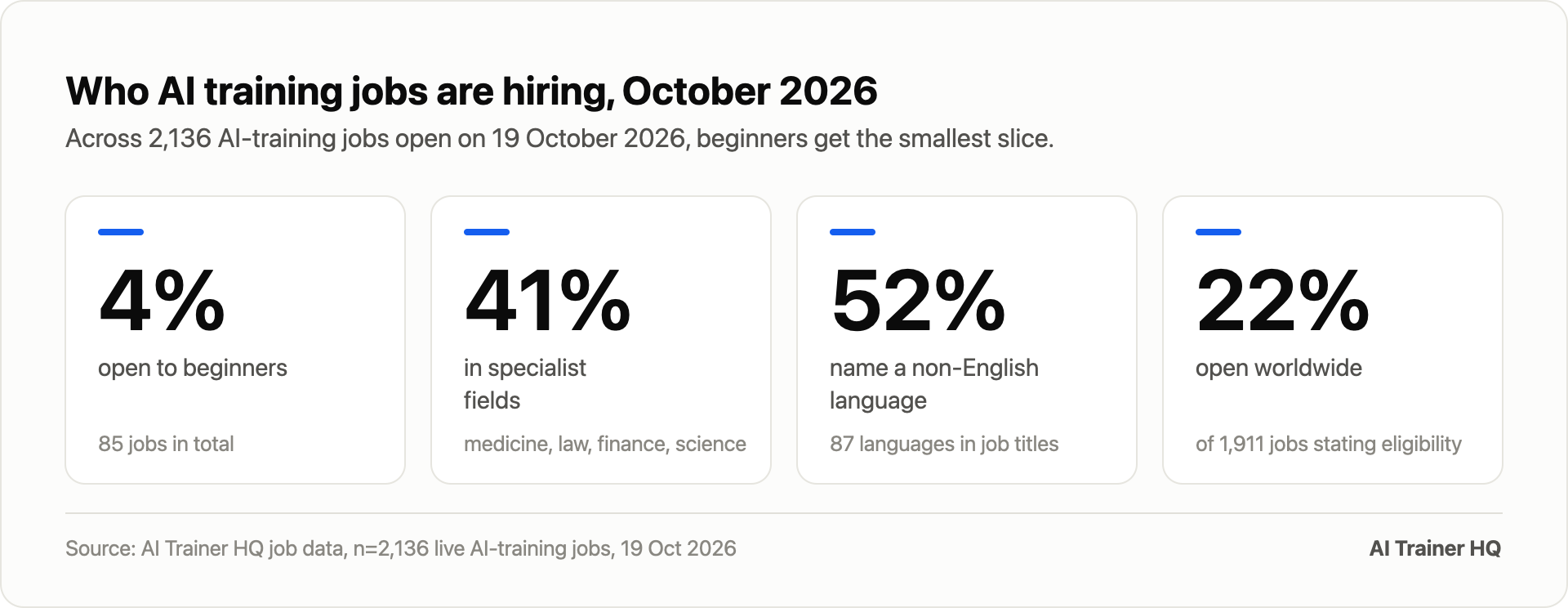 Four takeaways from 2,136 live AI-training jobs.
1. Beginner jobs are scarce. 85 jobs need no experience, every one from 3 of the 11 platforms: Meridial, RWS TrainAI and Welo Global.
2. The job type sets your odds. Search-rating jobs accept beginners 36% of the time, voice jobs 11%. Coding sits at 0%; medicine and law combine for 0 of 228.
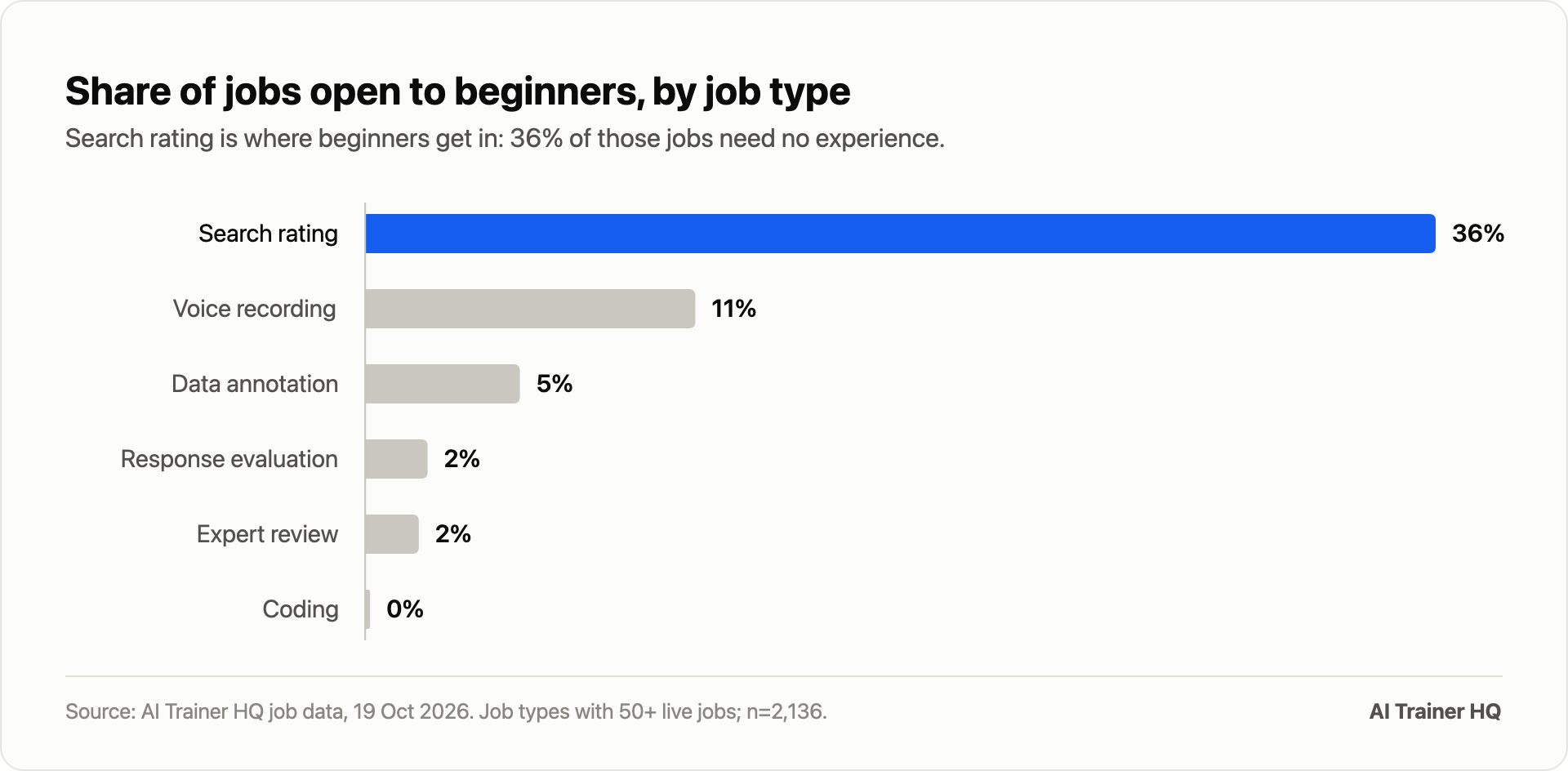 Search rating is the beginner-friendly entry point. Job types with 50 or more live jobs.
3. Language is your biggest asset. A non-English language appears in 52% of jobs, 87 languages in all.
| Field (50+ jobs) | Beginner jobs |
|---|---|
| Language roles | 67 of 1,013 |
| Generalist | 10 of 235 |
| Finance | 6 of 166 |
| Software engineering | 1 of 233 |
| Science | 1 of 215 |
| Medicine | 0 of 145 |
| Law | 0 of 83 |
4. Most jobs accept a single country. Of the 1,911 jobs that state who may apply, 64% take one country and 15% are US-only. Specialist work crosses borders more easily: 30% of it is open worldwide, versus 17% of generalist and language roles.
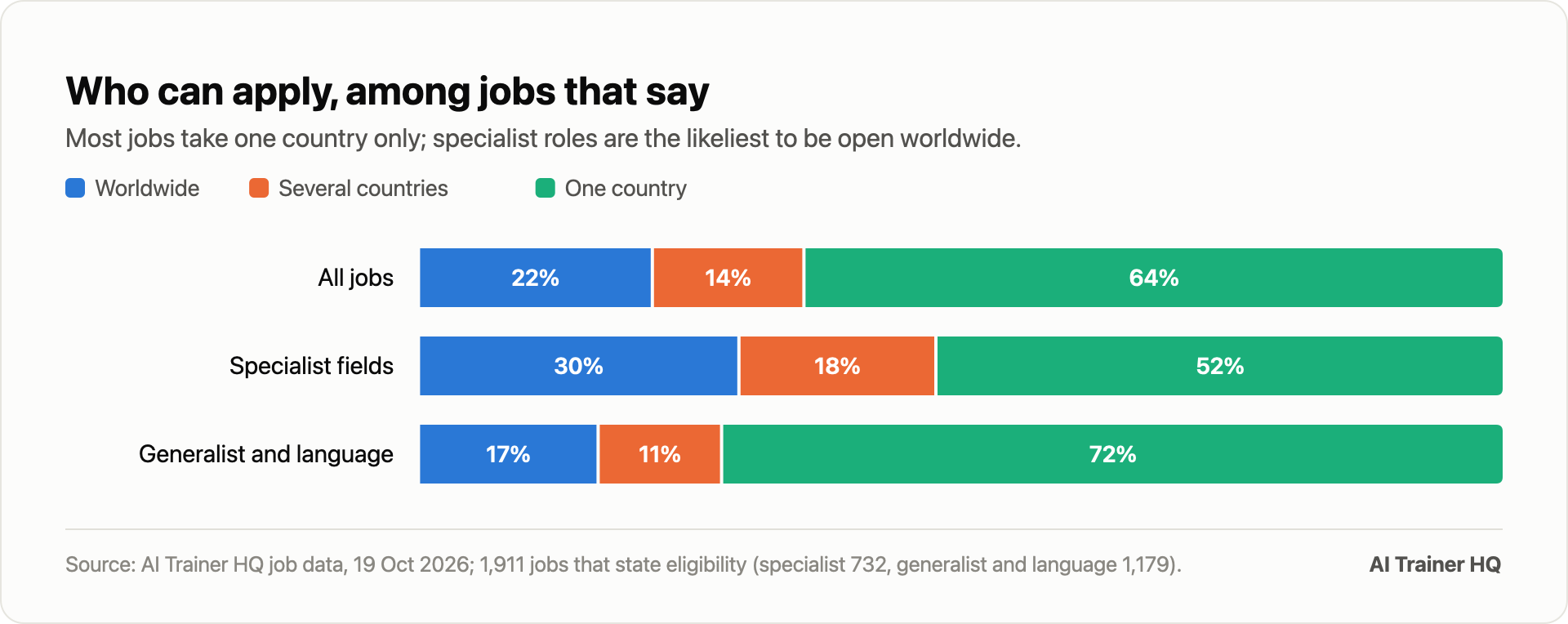 Only jobs that state which countries may apply.
What this means for you: lead with your language or field, and confirm your country is eligible before the test. OpenTrain put "entry level" at 78% in its September 2026 inventory because it counts any role needing no prior AI-training experience; we count only listings asking for no experience at all.
Do you need a degree or experience to become an AI trainer?
No single degree or credential is mandatory, though listings usually expect a language, a subject area or a coding skill. In our data, 36% of listings (767 jobs) name specific requirements. Of those, 49% call for language fluency, 19% for coding, 129 of 767 for a degree, 12% for a fixed number of years of experience and 3.5% for a licence or certification.
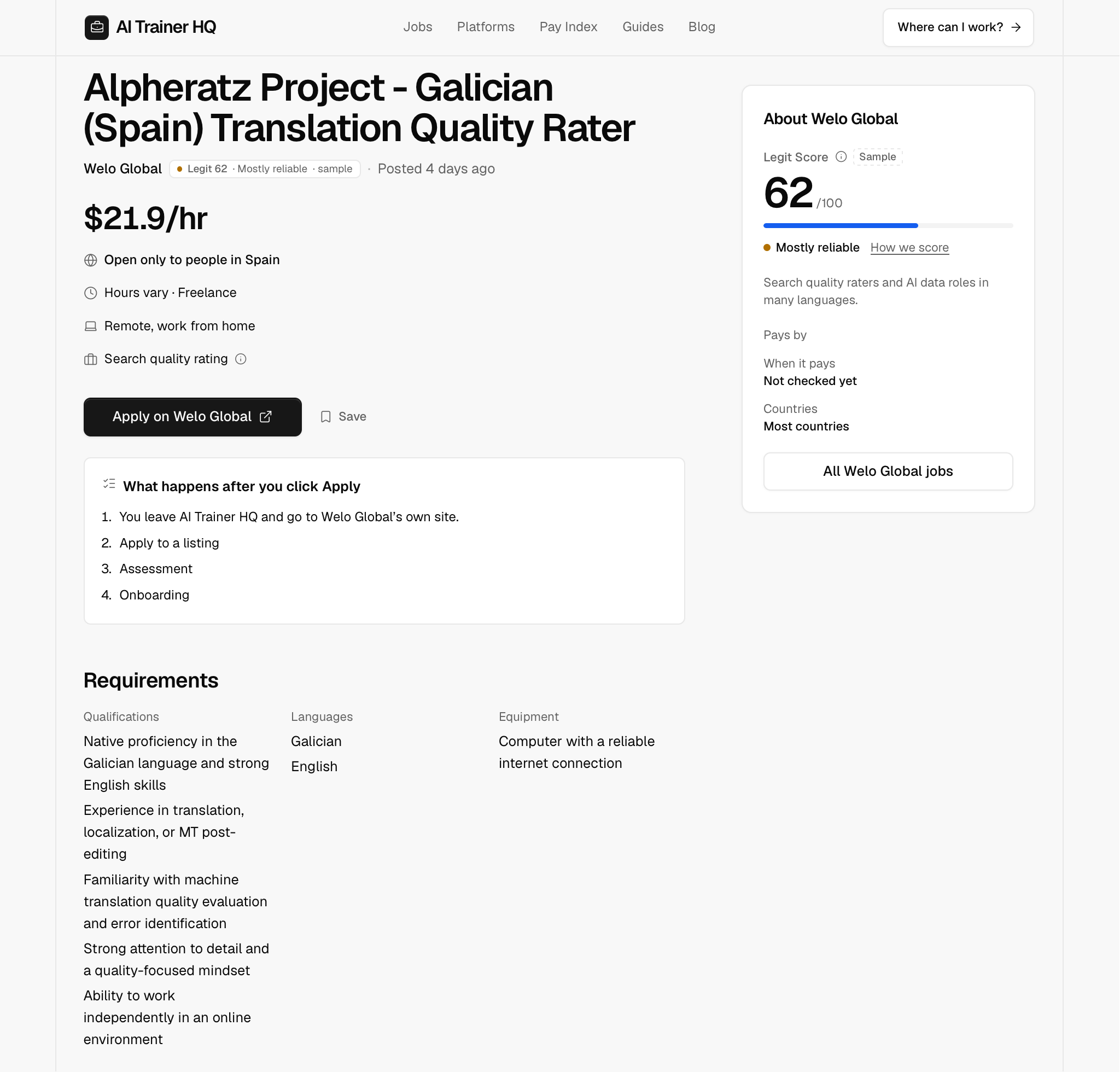 Every job page lists its requirements and accepted countries.
A few platforms draw a hard line: Outlier requires at least an associate degree from every contributor, and DataAnnotation asks for a degree or professional experience on its Coding, STEM and Professional tracks. You don't need an "AI trainer certification": none of the eight platforms we review asks for one.
Which route fits your background?
Your starting point depends on what you already bring. Before you apply anywhere, run the AI Trainer HQ Fit Check: (1) which track you fit (language, generalist or specialist), (2) whether your country is listed, and (3) which test you'll face.
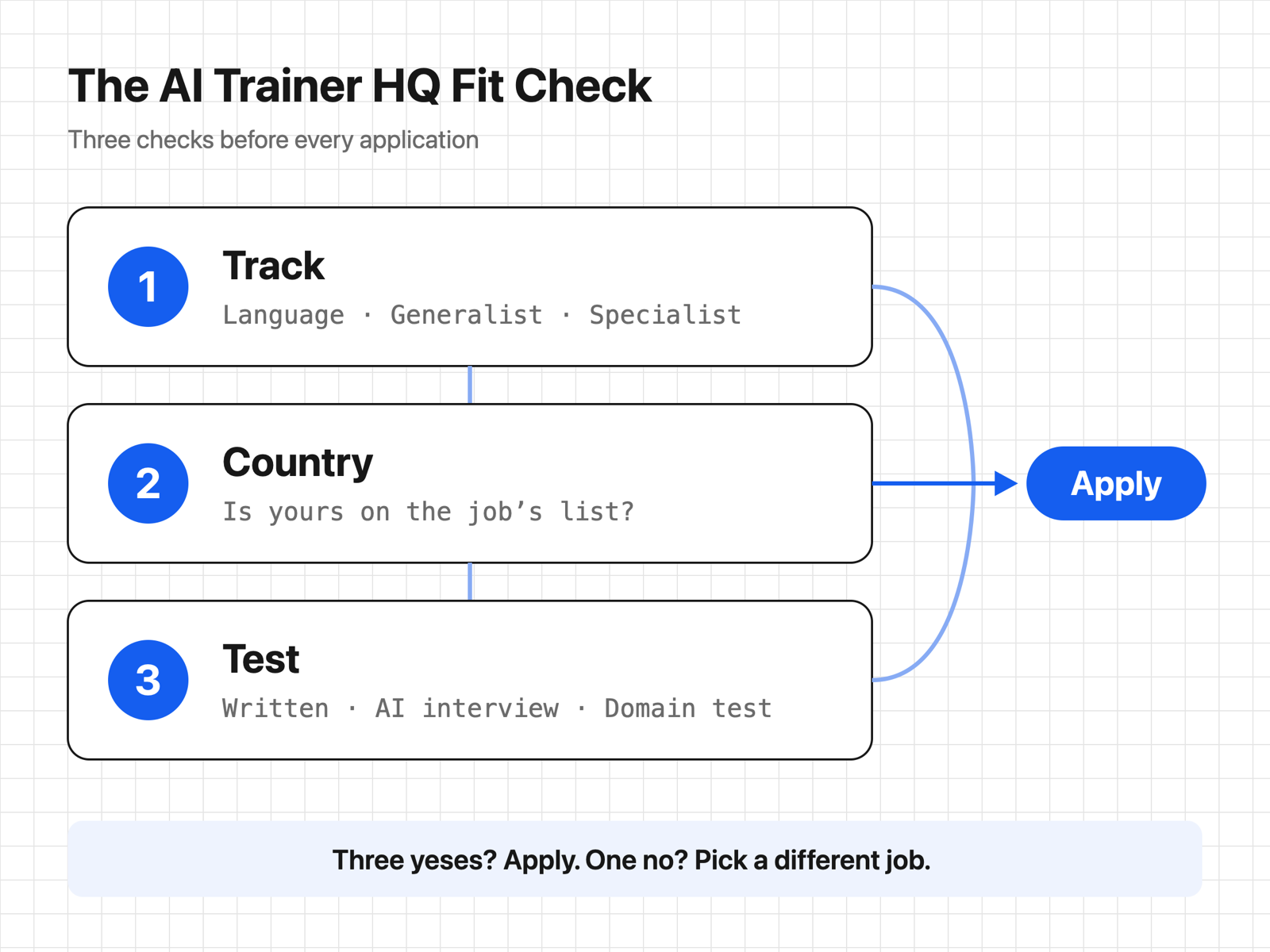 The Fit Check: three questions to answer before every application.
| Your background | Start with | Where to look | Trade-off |
|---|---|---|---|
| Native speaker of a non-English language | Search rating, language roles | Language jobs, search rater jobs | Usually one country only |
| US student or recent graduate | Handshake AI fellowship | Handshake AI review | US only |
| Licensed professional | Expert review on Mercor or micro1 | Law, medicine | Contracts may end early |
| Developer | Coding roles | Software engineering jobs | Tested in one language |
| Strong English writer, no specialty | DataAnnotation, generalist roles | DataAnnotation review | One-attempt test, silent rejections |
| Outside the US, no specialty | Worldwide generalist and language roles | Where can I work? | Fewer jobs to pick from |
Where AI Trainer HQ lands
- Best for: AI Trainer HQ shows which live jobs accept your country and level before you sit a test.
- Trade-off: we list jobs rather than hiring, so platforms that hire through one sign-up (DataAnnotation, Outlier, Prolific, Handshake AI) appear as reviews, not listings.
- Proof: 2,747 live jobs across 11 platforms, each re-checked every 24 hours.
How to become an AI trainer, step by step
Almost every platform uses the same sequence: track, country, application, test, ID check, first tasks.
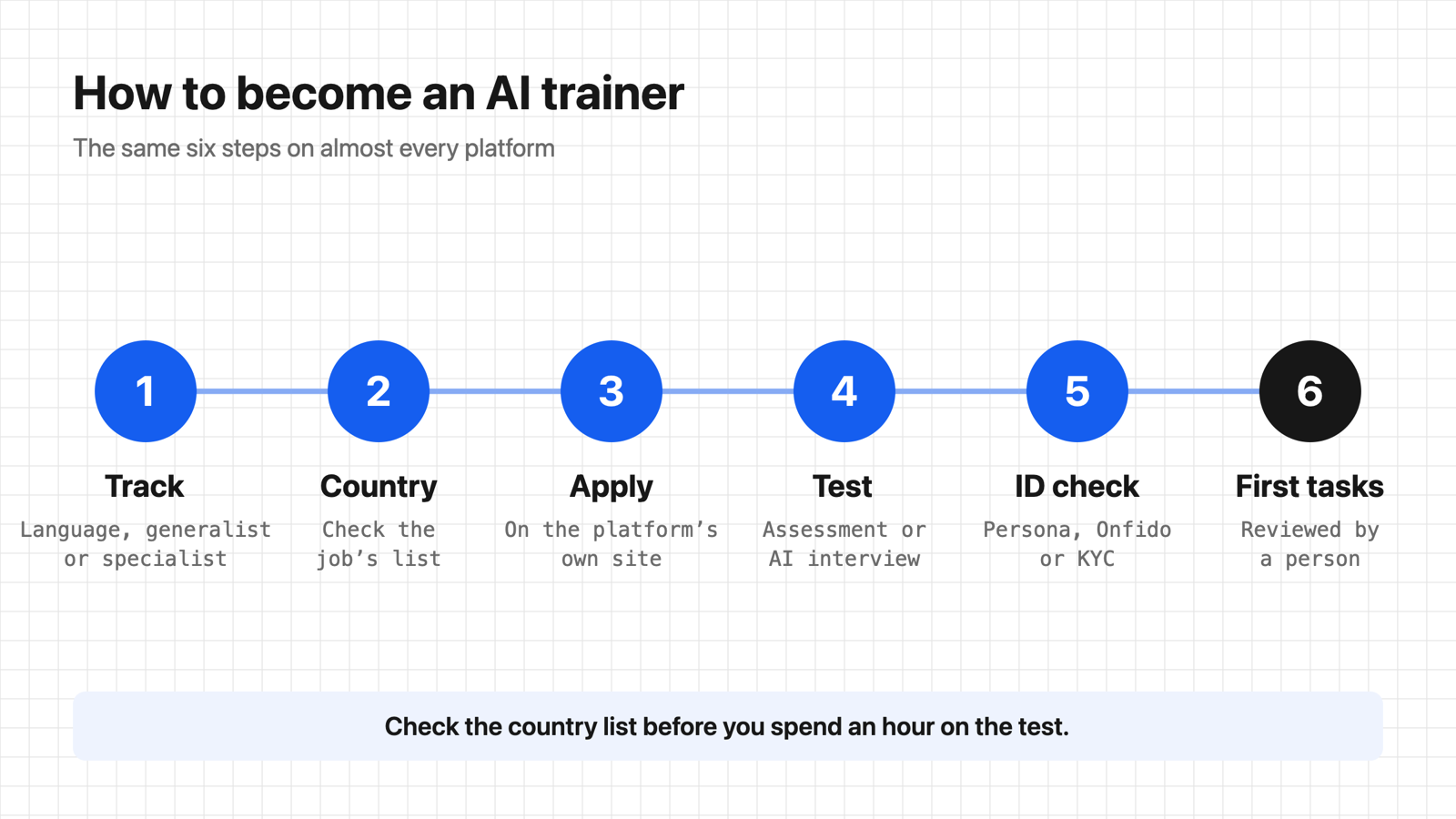 Six steps, nearly identical across platforms.
- Pick a track. The Fit Check above points the way. No professional field yet? Begin with entry-level AI training jobs.
- Confirm the country list. Our eligibility checker tells you which platforms take your country and profession.
- Use the platform's own site to apply. Lead your CV with languages, degree and licence.
- Clear the assessment or AI interview. See the table below.
- Prove your identity. Each of the eight platforms we review runs an ID check inside your account.
- Ease in. A reviewer typically checks your first paid tasks, and high quality scores unlock more work.
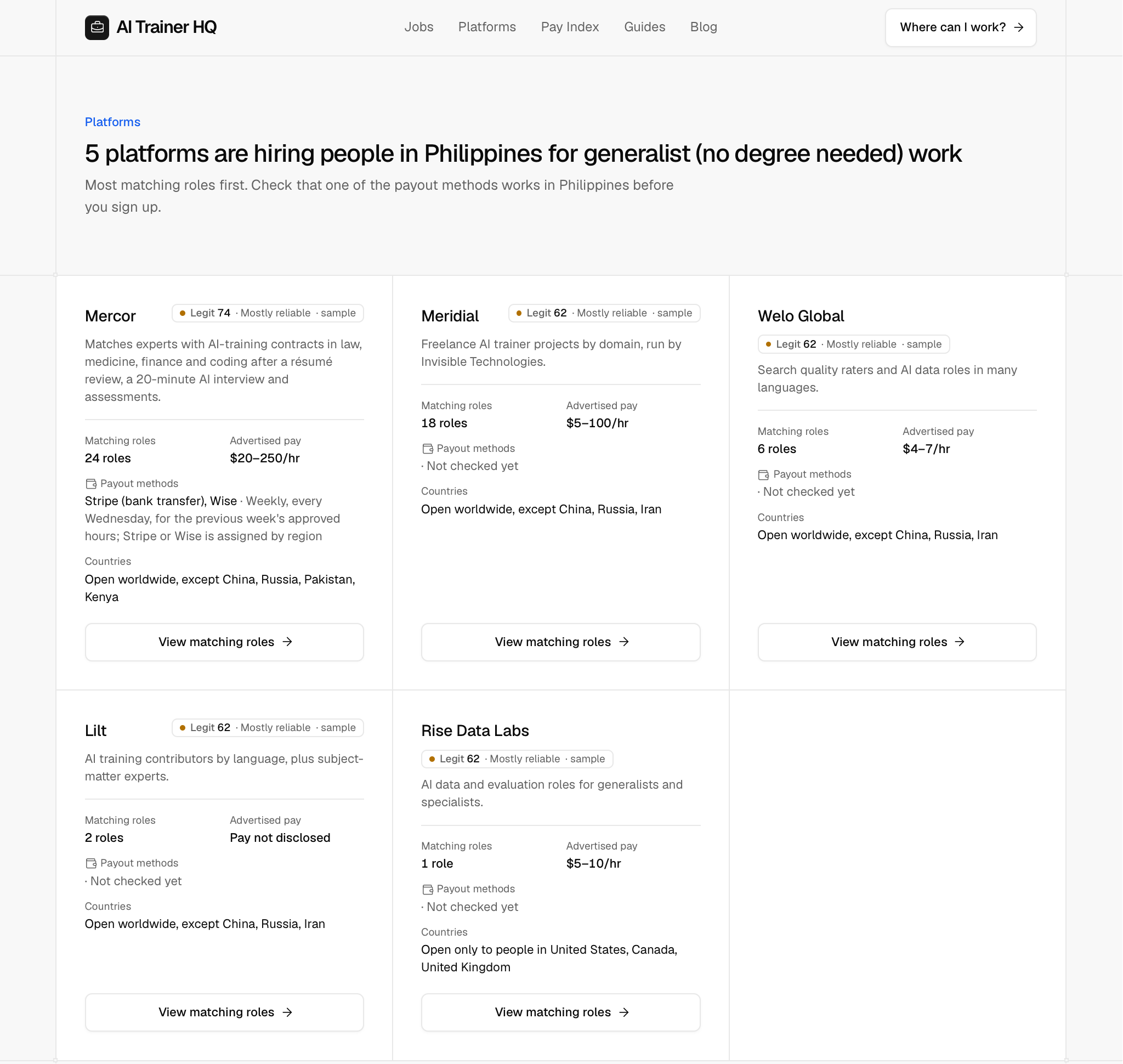 Set your country and profession.
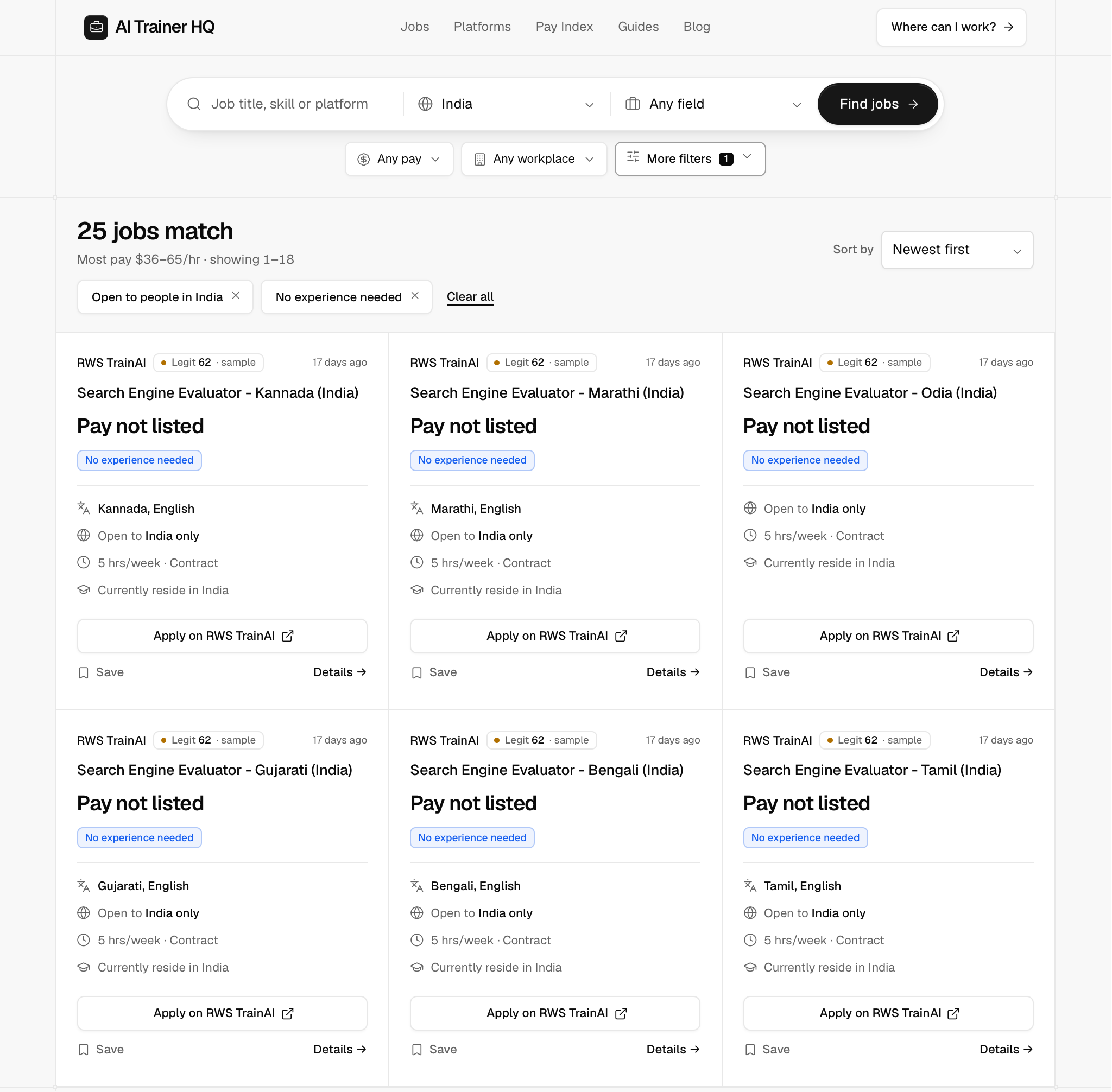 Entry-level openings in one country.
What do the tests and AI interviews look like?
Plan for an unpaid test lasting 30 minutes to two hours; Mercor, micro1 and certain Alignerr jobs add an AI interview.
| Platform | How you get in | AI interview | ID check | Countries accepted |
|---|---|---|---|---|
| DataAnnotation | Starter Assessment: roughly 1 hour, a single attempt | No | Persona | No published list |
| Outlier | Skill screenings, then tasks to qualify for each project | No | ID plus location | 117 |
| Mercor | Résumé review; some listings add a written test | Roughly 20 minutes | After an offer | 107 |
| micro1 | Screening questions; some roles add a technical test | Zara, roughly 20–40 minutes | KYC check | Every country but 21 |
| Alignerr | Résumé, with a domain assessment on some jobs | Zara on certain jobs | Persona | Worldwide, with some blocks |
| Handshake AI | Profile review, then matching to a project | No | Persona | US only |
| Mindrift | CV review; specialist projects add assessments | No | Identity check | Most countries |
| Prolific | Waitlist and an invite, then an AI task assessment | No | Onfido | 52 |
Verified against each platform's own help pages on October 18, 2026.
DataAnnotation gives you one shot at the Starter Assessment. Mercor is looser: up to three interview retakes, though each resets your application.
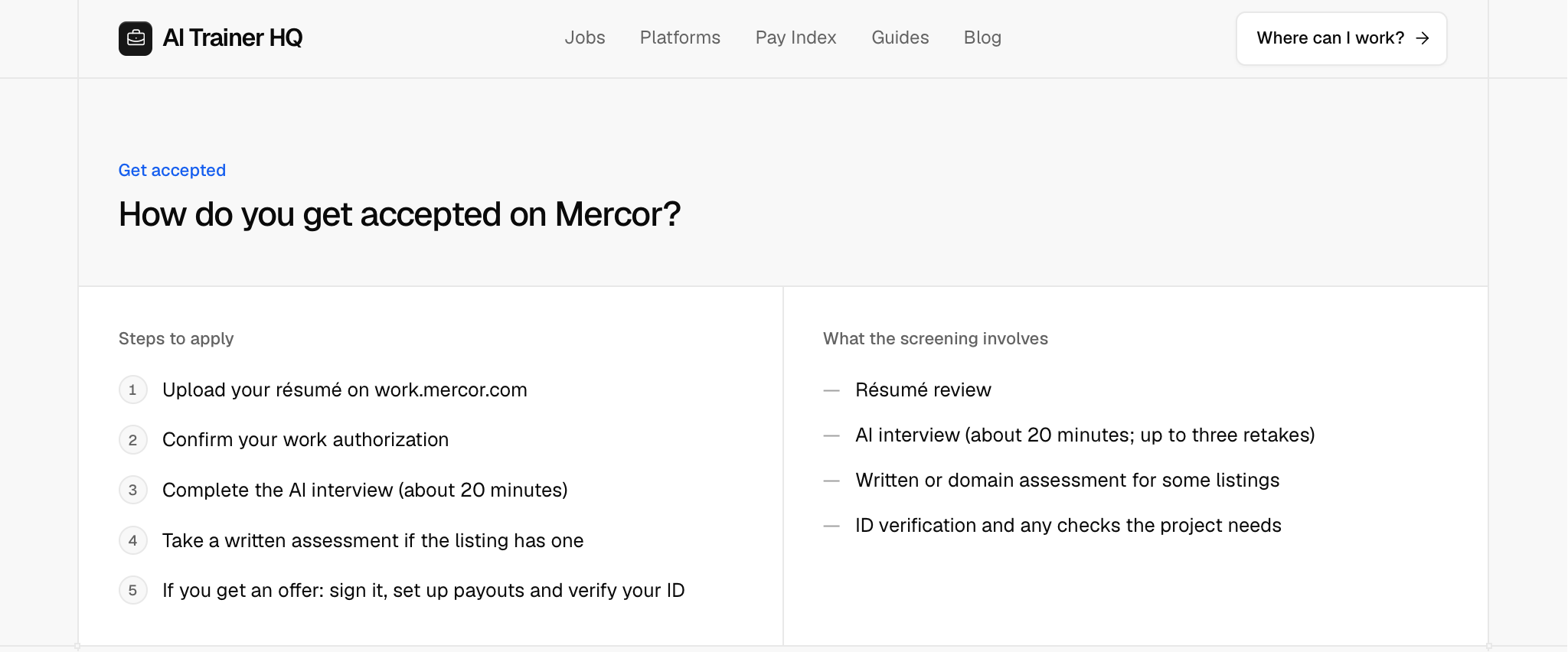 Every review lists the application steps.
How do you pass the assessment and keep your account?
How closely you follow the guidelines decides your score, so read them twice.
- Work with the guidelines open in another tab.
- For an AI interview, find a quiet room and test your camera and microphone.
- Don't open ChatGPT or other AI tools unless a project allows them. DataAnnotation's code of conduct bans them, and Handshake AI has kicked contractors off over it.
- Skip VPNs and second accounts; Outlier and Mindrift prohibit both.
How long does it take, and what happens after you're hired?
Plan on one to three hours for sign-up and the test. Replies take days to weeks, so apply to two or three platforms at once.
Work is freelance or contract, and projects start and stop. Extra qualification tests open better-paid projects. For rates and payout timing, see what AI training jobs pay. For fake recruiters or fee requests, see how to spot a fake AI training job.
Find jobs you can apply for today. Browse entry-level AI training jobs and pick your country.
FAQ
Can I become an AI trainer with no experience?
Yes: 85 live jobs need no experience, mostly in search rating and language work.
Do I need a certification to become an AI trainer?
No. Platforms test you directly instead.
Do AI trainers need to know how to code?
Only for coding roles, which test you in one language; none were entry level in our data.
Is it hard to become an AI trainer?
The screening is the hard part: some platforms allow only one attempt, and many never respond to rejected applicants.
Which platform is best for beginners?
Depends on fit: native speakers start with RWS TrainAI, Meridial and Welo Global, which posted every beginner job in our data; US students with Handshake AI. Choose AI Trainer HQ to filter live jobs by country and level first.
Can I become an AI trainer from outside the US?
Yes. Outlier takes 117 countries and territories, Mercor 107; Handshake AI is US only.
Is being an AI trainer a full-time job?
Usually not. Most roles are freelance or contract, with shifting hours.